Many students study in systems where marks are given in percentages. Later, when they apply to colleges or universities, they are asked for GPA instead of percentage. This creates confusion because percentage and GPA are not the same thing. Both are used to measure academic performance, but they work in different ways. That is why percentage to GPA conversion becomes important for students, especially those planning to study abroad.
Understanding this conversion helps students know where they stand academically. It also helps universities compare students from different education systems. When students know how their percentage changes into GPA, they feel more confident during admissions and avoid unnecessary stress.
What Is Percentage System
The percentage system is one of the most common grading methods in the world. In this system, students receive marks out of 100. For example, if a student scores 80 out of 100, the percentage is 80%. This system is simple and easy to understand, which is why many schools and boards use it.
Percentages show how many marks a student has scored overall. However, percentages can vary in meaning from country to country. In some systems, getting 70% is considered very good, while in others it may be average. Because of these differences, percentage alone is not always enough for international comparison.
What Is GPA System
GPA stands for Grade Point Average. It is a number that shows a student’s average academic performance on a fixed scale, most commonly the 4.0 scale. Instead of marks out of 100, grades are given points. These points are then averaged to find the GPA.
The GPA system makes it easier for colleges to compare students. A higher GPA means better academic performance. GPA is widely used in countries like the USA, Canada, and many universities around the world. This is why students coming from percentage systems often need to convert their scores into GPA.
Why Conversion Is Needed
Percentage to GPA conversion is needed because universities cannot compare different grading systems directly. A student with 85% from one country may not be equal to a student with 85% from another country. GPA conversion helps solve this problem by placing students on a common scale.
Conversion is also important for admissions and scholarships. Many universities set GPA requirements instead of percentage cutoffs. Without proper conversion, a student’s academic strength may not be shown correctly. Learning how conversion works helps students apply with clarity and avoid mistakes.
Basic Percentage to GPA Method
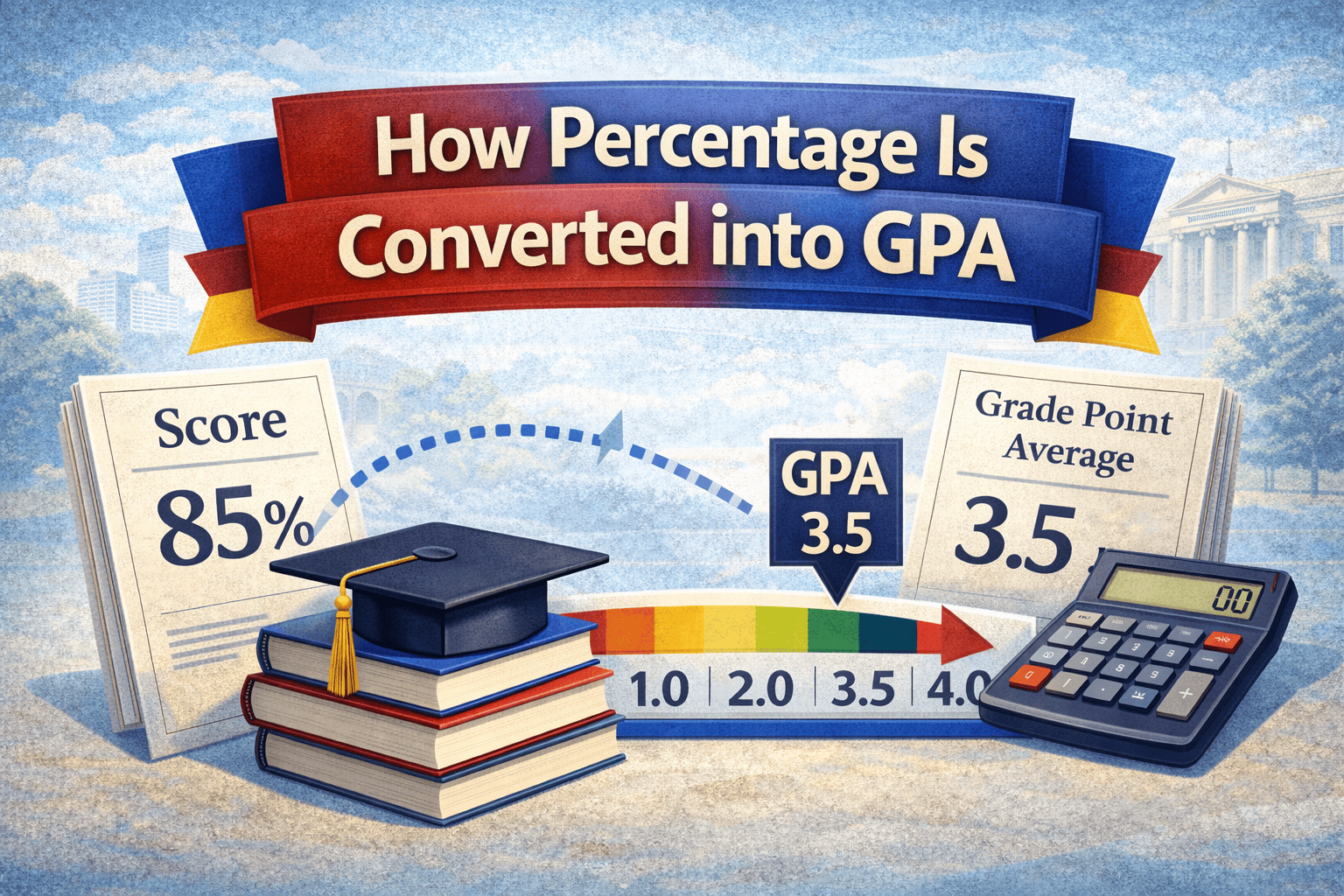
The basic method of converting percentage into GPA is simple, but it is not exact. Usually, percentages are placed into GPA ranges. For example, higher percentages are matched with higher GPA points, and lower percentages match lower GPA points. This method gives a general idea of academic level, but it may change from one institution to another.
Students should remember that this method is only for understanding and planning. Universities may use their own official conversion rules. Still, learning the basic method helps students estimate their GPA and prepare better for applications.
Different Country Rules
Different countries follow different rules for percentage to GPA conversion. Some countries use strict charts, while others use flexible ranges. This is why one percentage score may convert into different GPA values in different places.
Because of this, students should not assume that one conversion rule applies everywhere. Always check the official requirements of the college or university. Knowing these differences helps students avoid confusion and wrong expectations. you can also read: International GPA Conversion Explained
Conversion for College Admission
For college admission, percentage to GPA conversion is very important. Many universities ask for GPA even if a student studied in a percentage system. Admissions teams use the converted GPA to check if the student meets entry requirements.
A strong converted GPA can increase chances of admission and scholarships. However, GPA is not the only factor. Universities also look at subjects studied and overall academic history. Still, correct conversion helps present a student’s performance in the best way.
Common Conversion Mistakes
One common mistake students make is using random online converters without checking accuracy. Another mistake is comparing their GPA with friends from different systems. This can lead to stress and wrong conclusions.
Some students also think conversion guarantees admission, which is not true. GPA is just one part of the application. Understanding these mistakes helps students apply wisely and stay confident.
Conclusion:
Percentage to GPA conversion helps students move between different education systems. It makes academic comparison fair and clear. By understanding how conversion works, students can plan better and avoid common errors. Correct conversion helps students show their true academic ability during admissions.
FAQs:
Q1: Is percentage to GPA conversion the same everywhere?
No, different universities use different rules.
Q2: Can I convert my percentage into GPA by myself?
You can estimate, but official conversion is done by universities.
Q3: Are online GPA converters accurate?
They give an idea, but not exact results.
Q4: Is GPA conversion important for scholarships?
Yes, many scholarships use converted GPA.