
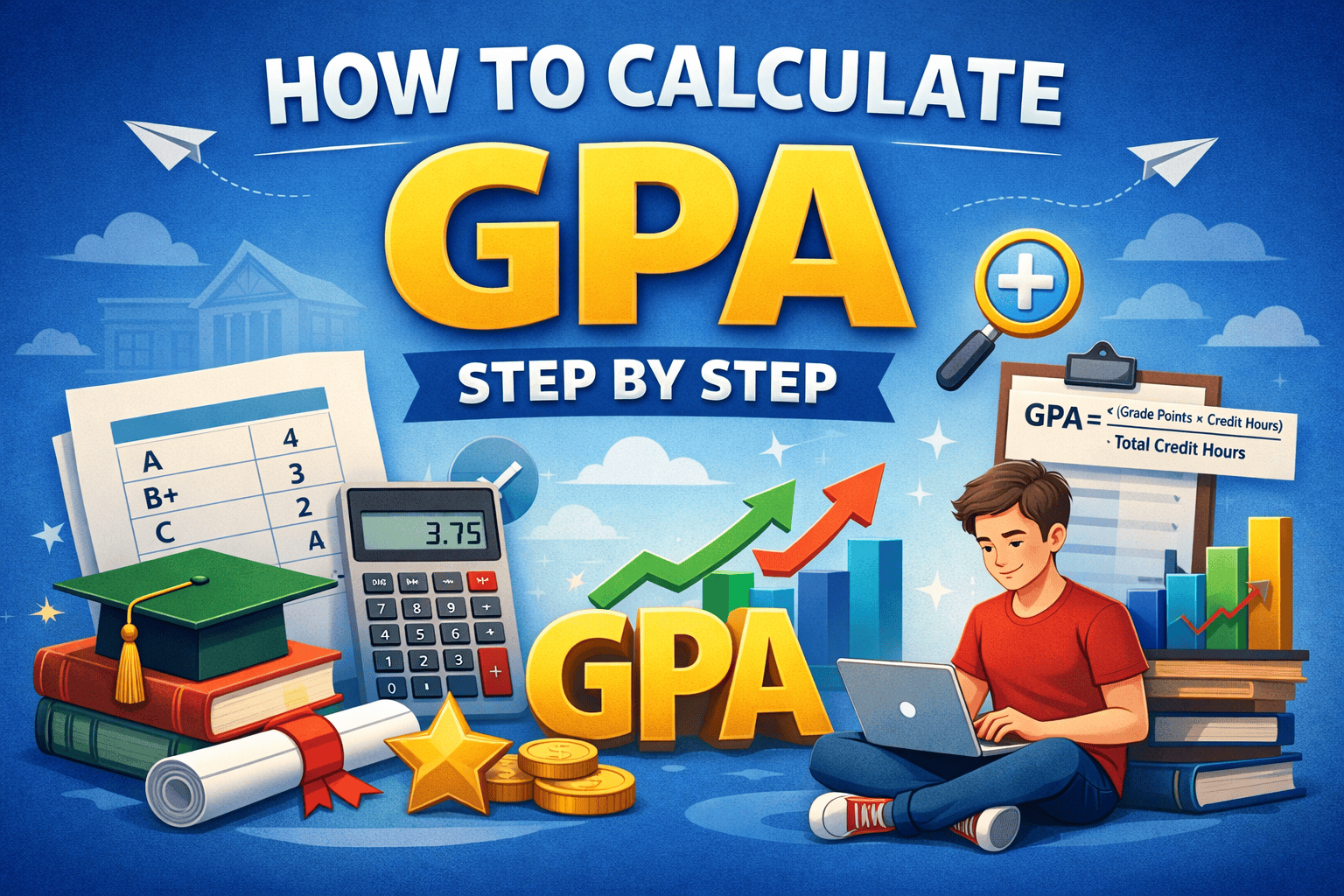
GPA stands for Grade Point Average. It is a numerical value that shows a student’s overall academic performance during a semester or an academic year. Instead of looking at individual subject marks, GPA gives a combined picture of how well a student is performing in all subjects. That is why schools, colleges, and universities around the world use GPA as a standard measurement system.
GPA is important because it affects many aspects of a student’s academic life. Universities use GPA to decide admissions, scholarships, and sometimes even internships. A strong GPA shows that a student is consistent, disciplined, and serious about studies. On the other hand, a low GPA may limit opportunities, especially when applying for higher education or competitive programs.
Many students feel confused or stressed about GPA because they do not clearly understand how it is calculated. Once you understand the GPA system properly, it becomes much easier to plan your studies and set realistic academic goals. Knowing your GPA also helps you track your progress and identify subjects where you need improvement.
Understanding the GPA Grading System (4.0 Scale Explained)
Most educational institutions follow the 4.0 GPA scale, which is one of the most common grading systems worldwide. In this system, each letter grade is converted into a numerical value called a grade point. These grade points are then used to calculate the final GPA.
Here is a basic idea of how the 4.0 scale works:
- A or A+ usually equals 4.0
- B usually equals 3.0
- C usually equals 2.0
- D usually equals 1.0
- F equals 0.0
Some institutions also use plus and minus grades, such as B+ or A−, which slightly change the grade points. However, the overall concept remains the same. Higher grades earn higher points, and lower grades earn fewer points.
Understanding this grading scale is very important before calculating GPA. If you do not know the correct grade points assigned by your institution, your GPA calculation may be incorrect. Always check your university or college grading policy to confirm the exact scale they follow.
Difference Between GPA, CGPA, and Percentage
Many students mix up GPA, CGPA, and percentage, even though they represent different things. Understanding the difference between them helps avoid confusion, especially when filling out admission forms or academic records.
GPA (Grade Point Average) usually represents performance for one semester or term. It focuses only on the subjects studied during that specific period.
CGPA (Cumulative Grade Point Average) is the overall average of GPA from multiple semesters. It shows a student’s academic performance over a longer period, such as an entire degree program.
Percentage, on the other hand, is a traditional marking system where scores are shown out of 100. Some institutions still use percentages, while others have shifted completely to GPA systems.
Each system has its own purpose. GPA and CGPA are more commonly used internationally, while percentage systems are still popular in some regions. When converting between these systems, always follow official conversion rules to avoid errors.
How Credit Hours Affect Your GPA Calculation
Credit hours play a very important role in GPA calculation, and ignoring them can lead to wrong results. Every subject or course carries a specific number of credit hours based on its importance, workload, and weekly class time.
Subjects with more credit hours have a greater impact on your GPA. For example, a subject with 4 credit hours affects your GPA more than a subject with 2 credit hours. This means performing well in high-credit subjects can significantly boost your GPA, while poor performance can lower it quickly.
When calculating GPA, each subject’s grade point is multiplied by its credit hours. These values are then added together and divided by the total number of credit hours. This weighted system ensures fairness by giving more importance to major subjects.
That is why students should always focus extra attention on courses with higher credit hours. Understanding this concept makes GPA calculation logical and helps students make smarter academic decisions.
Step-by-Step Method to Calculate GPA Manually
Calculating GPA manually may look difficult at first, but once you understand the steps, it becomes very simple. The first thing you need is your subject grades and their credit hours. Every subject has a grade (like A, B, or C) and a fixed number of credit hours assigned by your institution.
Start by converting each subject grade into its grade point according to your grading scale. For example, if you got an A in a subject, it usually means 4.0 points. After that, multiply the grade point of each subject by its credit hours. This gives you the quality points for each course.
Once you have the quality points for all subjects, add them together. Then, add all the credit hours of your subjects. Finally, divide the total quality points by the total credit hours. The result you get is your GPA for that semester. This method is accurate and helps you understand how each subject contributes to your final GPA.
Common GPA Calculation Mistakes Students Make
Many students calculate their GPA incorrectly because of small but common mistakes. One of the biggest errors is ignoring credit hours. Treating all subjects as equal can give a wrong GPA, especially when some courses carry more weight than others.
Another common mistake is using the wrong grading scale. Some institutions use a 4.0 scale, while others may use a 5.0 or 10.0 scale. If you apply the wrong scale, your GPA result will not be accurate. Always check your university’s official grading policy.
Students also sometimes round numbers too early during calculation. This can slightly change the final GPA. It is always better to keep decimal values until the final step. Avoiding these mistakes ensures your GPA is calculated correctly and reflects your true academic performance.
How to Calculate GPA Using an Online GPA Calculator
For students who want quick and accurate results, using an online GPA calculator is a very convenient option. Online tools remove the need for manual calculations and reduce the chances of errors. You simply enter your grades and credit hours, and the calculator does the rest.
Online GPA calculators are especially helpful when you have many subjects or multiple semesters to calculate. They save time and give instant results, making them ideal for students who want to track their performance regularly.
If you want an easy and reliable way to calculate your GPA, you can use a trusted GPA calculator like the one available on gpacalc.online. It is designed to be user-friendly and works well for different grading systems.
Tips to Improve Your GPA Over Time
Improving your GPA is possible with the right approach and consistent effort. One of the most effective ways is to focus more on high-credit subjects, as they have a bigger impact on your GPA. Performing well in these courses can significantly improve your overall score.
Good time management also plays a key role. Creating a realistic study schedule helps you stay organized and reduces last-minute stress. Regular revision, asking questions in class, and seeking help when needed can greatly improve your understanding of difficult topics.
It is also important to learn from past mistakes. Analyze which subjects lowered your GPA and work on improving those areas. With patience and dedication, even a low GPA can improve over time.
Conclusion:
Understanding how to calculate GPA step by step gives students clarity and confidence in managing their academic performance. Whether you calculate it manually or use an online GPA calculator, the key is knowing how grades and credit hours work together. A clear understanding of GPA helps you set goals, track progress, and plan your academic future more effectively.
FAQs:
What is a good GPA for university students?
A GPA of 3.0 or above is generally considered good, but this may vary depending on the institution and program.
Can I calculate GPA without credit hours?
No, credit hours are essential for accurate GPA calculation because they determine the weight of each subject.
Is GPA the same in every country?
No, GPA systems can differ between countries and institutions, so always check the grading scale used by your university.
How often should I calculate my GPA?
It is best to calculate your GPA at the end of every semester to track your academic progress.