GPA Calculation Formula Explained Simply

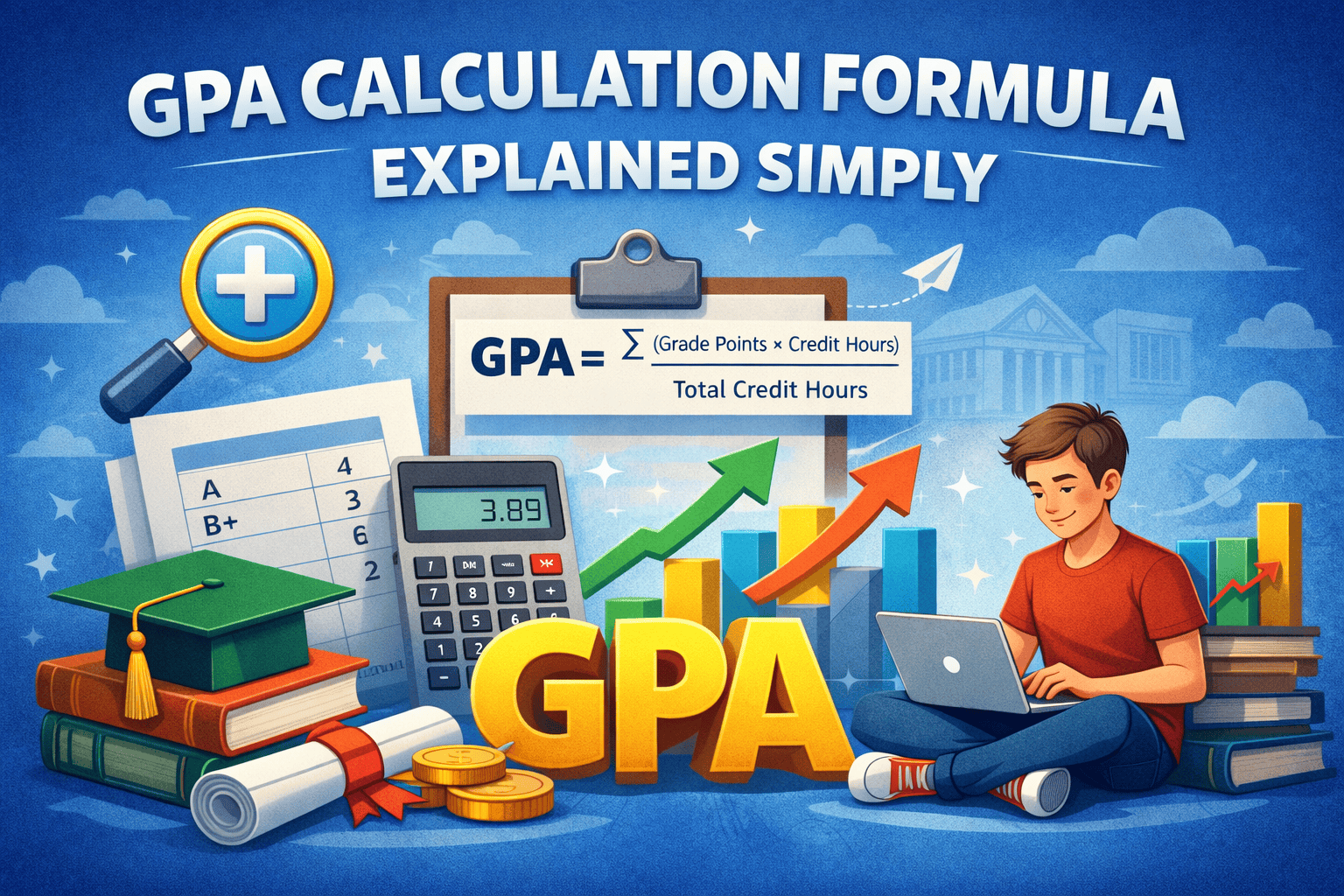
The GPA calculation formula is a simple mathematical method used to find a student’s Grade Point Average for a specific semester or academic term. Instead of looking at marks for each subject separately, this formula combines all subjects into one final score. The main purpose of the GPA formula is to show a student’s overall academic performance in a clear and standardized way.
At its core, the GPA formula works by converting letter grades into numerical values known as grade points. These grade points are then multiplied by the credit hours of each subject. This step ensures that subjects with more importance or workload have a stronger impact on the final GPA. Once all subjects are included, the formula calculates an average that accurately represents the student’s performance.
Understanding this formula helps students remove confusion and fear around GPA. When you know how the formula works, GPA is no longer just a number on your result card. It becomes a meaningful indicator that you can control and improve through better planning and consistent effort.
Why Understanding the GPA Formula Is Important for Students
Many students focus only on final grades and completely ignore how those grades are calculated. This lack of understanding often leads to stress, wrong expectations, and poor academic decisions. Knowing the GPA calculation formula gives students clarity and helps them take responsibility for their academic performance.
When students understand the formula, they can clearly see how each subject affects their GPA. They realize that high-credit courses play a bigger role than low-credit ones. This awareness allows students to prioritize their time and energy more effectively, especially during exams and assignment periods.
Understanding the GPA formula also helps when setting academic goals. Whether you are aiming for a scholarship, admission to a university, or maintaining a minimum GPA requirement, knowing the formula allows you to plan realistically. It turns GPA from a confusing system into a tool for academic success.
Key Elements Used in the GPA Formula (Grades & Credit Hours)
The GPA calculation formula is based on two main elements: grades and credit hours. Both of these components work together to produce the final GPA, and ignoring either one can lead to incorrect results.
Grades represent your performance in each subject and are usually given in letters such as A, B, C, or D. These letter grades are later converted into numerical values called grade points. Credit hours, on the other hand, represent the weight or importance of a subject. A subject with more weekly classes or workload usually has more credit hours.
The GPA formula uses credit hours to give fair importance to each subject. This means that performing well in major subjects has a stronger impact on your GPA than minor ones. Once students understand how grades and credit hours interact, the GPA formula becomes logical and easy to follow.
How Grade Points Are Assigned in the GPA Formula
Grade points are numerical values assigned to letter grades to make GPA calculation possible. Most institutions follow a 4.0 grading scale, where higher grades receive higher grade points. This system ensures consistency and fairness in academic evaluation.
For example, an A grade usually carries 4.0 grade points, while a B grade may carry 3.0 points. Lower grades receive fewer points, and a failing grade typically receives 0.0 points. Some institutions also use plus and minus grades, such as A- or B+, which slightly adjust the grade points.
It is important to always use the official grading scale provided by your institution. Different universities may assign slightly different grade point values. Using the correct grade points ensures that your GPA calculation is accurate and reliable.
The Standard GPA Calculation Formula Explained Step by Step
The standard GPA calculation formula is designed to give a fair average of a student’s academic performance by considering both grades and credit hours. The basic formula used by most institutions is:
GPA = Total Grade Points ÷ Total Credit Hours
To apply this formula, the first step is to calculate the grade points for each subject. This is done by multiplying the grade point value of a subject by its credit hours. For example, if a subject has 3 credit hours and you earned a grade worth 4.0 points, the total grade points for that subject would be 12.0.
After calculating grade points for all subjects, the next step is to add them together. Then, you add all the credit hours of your subjects. Finally, divide the total grade points by the total credit hours. The result you get is your GPA. This step-by-step process ensures that every subject is counted fairly according to its importance.
Example of GPA Calculation Using the Formula
Understanding the GPA formula becomes much easier when you look at a practical example. Imagine a student studied four subjects in one semester, each with different grades and credit hours. Each grade is first converted into grade points based on the institution’s grading scale.
Once the grade points are multiplied by their respective credit hours, the student adds all the results together. The total grade points are then divided by the total credit hours. The final number represents the student’s GPA for that semester.
This example clearly shows how higher grades in high-credit subjects can significantly improve GPA. It also highlights why consistent performance across all subjects is important. Practical examples help students understand not just the formula, but the logic behind it.
Manual GPA Formula vs Online GPA Calculator
Students can calculate GPA either manually using the formula or by using an online GPA calculator. Manual calculation is helpful for understanding how GPA works, especially for beginners who want to learn the system properly. It also helps in verifying results and avoiding confusion.
However, online GPA calculators are faster and more convenient, especially when dealing with multiple subjects or semesters. These tools automatically apply the GPA formula once you enter grades and credit hours, reducing the chances of mistakes.
For quick and accurate results, many students prefer using an online tool like gpacalc.online, which simplifies the GPA calculation process and saves time. Both methods are useful, and students can choose based on their needs and comfort level.
Common Errors Students Make While Using the GPA Formula
Even though the GPA formula is simple, students often make small mistakes that lead to incorrect results. One common error is forgetting to multiply grade points by credit hours. This mistake treats all subjects equally, which is not how GPA is designed.
Another common problem is using the wrong grading scale. Some students assume all institutions follow the same system, which is not true. Using incorrect grade point values can significantly change the final GPA. Rounding numbers too early during calculation is also a frequent mistake.
Avoiding these errors ensures that the GPA formula gives accurate and reliable results. Careful calculation and correct information are key to understanding your true academic performance.
Conclusion:
The GPA calculation formula is a powerful tool that helps students measure their academic performance in a clear and structured way. Once you understand how grade points and credit hours work together, GPA becomes easy to calculate and manage. Whether you calculate it manually or use an online GPA calculator, knowing the formula gives you control over your academic journey and helps you plan for future success.
FAQs:
What is the basic GPA calculation formula?
The basic formula is total grade points divided by total credit hours.
Can GPA be calculated without credit hours?
No, credit hours are essential because they determine the weight of each subject.
Is the GPA formula the same for all universities?
The formula is similar, but grading scales and grade point values may vary.
Should I calculate GPA manually or online?
Manual calculation helps understanding, while online calculators are faster and more convenient.